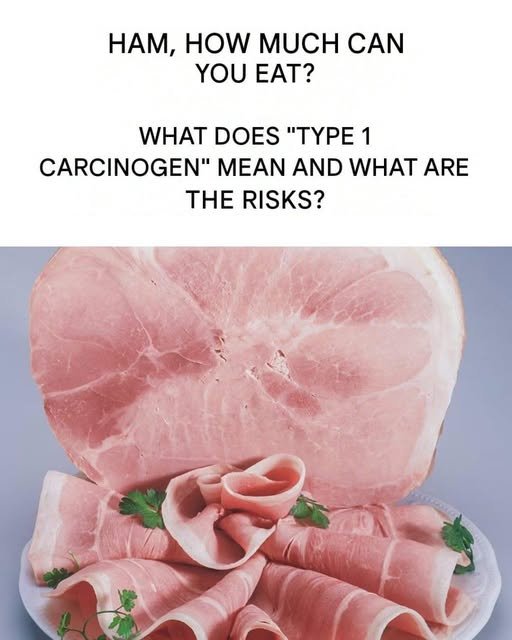
Cooked Ham: How Much Can You Eat? What Does “Type 1 Carcinogen” Really Mean?
Ham is a convenient source of protein and is a familiar ingredient in sandwiches, breakfasts, salads, and many everyday meals. But because ham is generally classified as processed meat, there is an important health question: how much is reasonable to eat?
The answer requires some context. Processed meat has been classified by the International Agency for Research on Cancer (IARC) as a Group 1 carcinogen, meaning there is sufficient scientific evidence that consuming processed meat can cause cancer in humans. But this classification is often misunderstood. It does not mean that eating ham carries the same level of risk as smoking cigarettes. Organisation mondiale de la santé
What Is Processed Meat?
Processed meat is meat that has been transformed through methods such as salting, curing, smoking, fermentation, or the addition of preservatives to improve flavor or preservation.
Examples include:
Ham
Bacon
Salami
Sausages
Hot dogs
Chorizo
Pepperoni
Corned beef
Many deli meats
So even if ham is made from a relatively lean cut of pork, the processing method means it falls into the processed-meat category. World Cancer Research Fund
What Does “Group 1 Carcinogen” Mean?
This is one of the most important points to understand.
IARC’s Group 1 classification means that there is sufficient evidence that an agent can cause cancer in humans. It describes the strength of the evidence, not the size of the risk.
For example, tobacco smoke and asbestos are also in Group 1. That does not mean that eating ham is as dangerous as smoking or asbestos exposure. The actual level of risk depends on factors including the amount and frequency of exposure. Organisation mondiale de la santé
What Cancer Is Linked to Processed Meat?
The strongest established link is with colorectal (bowel) cancer.
According to IARC, analysis of available studies found that consuming 50 grams of processed meat every day was associated with approximately an 18% higher relative risk of colorectal cancer. Organisation mondiale de la santé
This is a population-level estimate—not a prediction that an individual who eats 50 grams of ham will develop cancer.
The World Cancer Research Fund similarly reports that bowel-cancer risk increases with processed-meat consumption and recommends eating little, if any, processed meat. World Cancer Research Fund
So, How Much Ham Can You Eat?
There isn’t a scientifically established amount of processed meat that can be guaranteed to carry zero increased cancer risk.
That is why the World Cancer Research Fund recommends consuming very little, if any, processed meat, rather than giving a specific weekly allowance for ham. World Cancer Research Fund
This doesn’t mean that eating a ham sandwich occasionally means you will develop cancer. Rather, regular consumption and increasing amounts are associated with increasing risk.
If you currently eat processed meat frequently, reducing the amount and replacing some servings with other protein sources is a practical approach.
Why Might Processed Meat Increase Cancer Risk?
Researchers are still studying the exact mechanisms, but several factors may contribute.
Processing can involve compounds such as nitrites and nitrates, while meat itself contains components that can contribute to the formation of potentially harmful compounds in the digestive tract. Cooking meat at high temperatures can also produce compounds of concern. World Cancer Research Fund
Processed meats can also contain substantial amounts of salt and saturated fat, depending on the product. World Cancer Research Fund
What Can You Eat Instead?
You don’t have to remove protein from your diet when reducing ham.
Possible alternatives include:
Fresh chicken
Fresh turkey
Fish
Eggs
Beans and lentils
Tofu and other plant-based proteins
Dairy products such as yogurt or cottage cheese
Replacing some processed-meat servings with these foods can make it easier to build a varied diet. World Cancer Research Fund
What About “Uncured” or “Nitrate-Free” Ham?
Labels can sometimes be confusing. A product marketed as “uncured” or “nitrate-free” isn’t necessarily equivalent to fresh, unprocessed meat.
The important question is how the meat has been processed, not simply whether a particular marketing term appears on the package.
Check the ingredient list and preparation method rather than assuming that one label automatically makes a product risk-free.
Should You Stop Eating Ham Completely?
For most people, the evidence doesn’t mean that an occasional serving of ham should cause panic.
The more useful message is to think about overall eating patterns and frequency. If processed meat is a daily part of your diet, reducing it is more relevant than worrying about an occasional meal.
The World Cancer Research Fund’s current recommendation is to eat little, if any, processed meat because of the evidence linking it to colorectal cancer. World Cancer Research Fund
The Bottom Line
Ham is classified as processed meat, and processed meat is classified by IARC as a Group 1 carcinogen because there is sufficient evidence that it can cause cancer, particularly colorectal cancer. Group 1 describes the certainty of the evidence—not that ham has the same danger level as tobacco or asbestos. Organisation mondiale de la santé
There is no established amount of processed meat that can be confidently described as completely risk-free. For cancer prevention, major cancer-research organizations recommend keeping processed meat consumption as low as practical and choosing a variety of less-processed protein sources.
This article is for general educational purposes and is not a substitute for personalized medical or dietary advice.